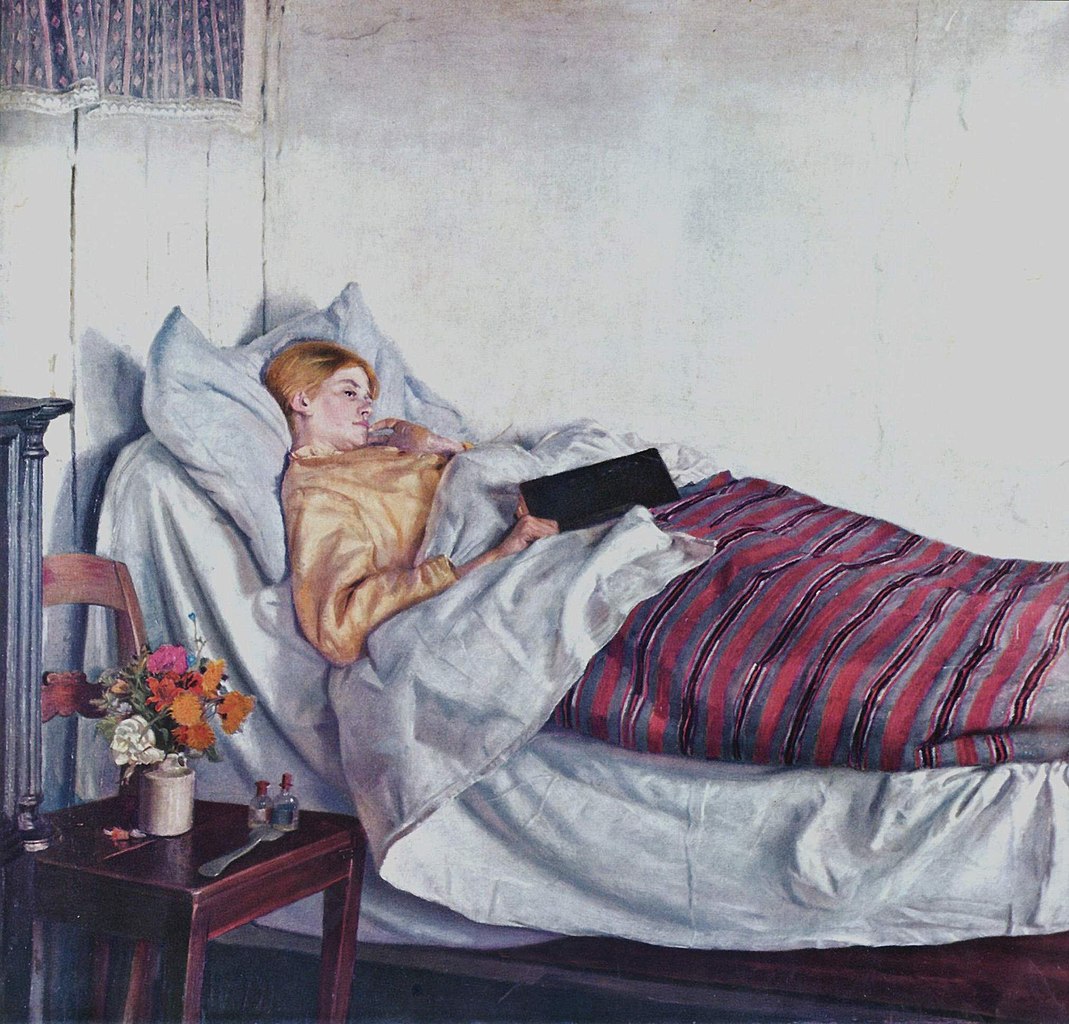
Sick Child
Edvard Munch, 1886
Collection:
National Museum of Art, Architecture and Design, Oslo
Documentation:
Maite van Dijk notes:
“It is a characteristic of nineteenth-century art criticism that motif and technique were not to be coupled in the evaluation of art works; critics generally discussed these aspects separately. An exception to this practice was G. Ivan’s description of Munch’s Sick Child [1896 version], exhibited in 1896 [at Salon des Indépendents], in which he combined the two elements: ‘material elements, human and dramatic (not anecdotic at all please) are mixed with pure emotions…’ He repeated his admiration for Munch’s technical skills in 1897: ‘Edvard Munch is a very savant and reasonable man who contemplates long on every brushstroke. He studies the reality very closely, certainly, but he mostly listens to it.’”
Maite van Dijk, “International Artists at the Salon des Indépendents in Paris: The Case of Edvard Munch (1896 and 1897), Foreign Artists and Communities in Modern Paris, 1870-1914. Strangers in Paradise, Karen L. Carter and Susan Waller, eds. (Surrey, UK-Burlington, VT: Ashgate, 2015), 47.
Progressive critic Andreas Aubert condemned Munch’s The Sick Child when it was exhibited in 1886:
“[I]t demonstrates that [Munch] is careless in his training. As this ‘Study’ (!) [title under which The Sick Child was exhibited] now appears, it is no more than a rough sketch, half of which has been scraped away. He himself became exhausted from the work. It is a miscarriage, of the sort that [Emile] Zola describes so well in his novel of artistic frustration The [Unknown] Masterpiece.”
Andreas Aubert review translated and excerpted in Reinhold Heller, Munch. His Life and Work (London: John Murray, 1984), 36.
An anonymous critic for the conservative Christiania (Oslo) newspaper Fæderlandet (Fatherland) praised The Sick Child :
“It is a ‘Study’ by E. Munch, one of the youngest painters, and without doubt one of the most modern ones among the modern Norwegian painters. It depicts a girl, mortally ill, sitting in a chair, her mother bending the head, crying. The motif is dim and obscure, and it takes time to understand it. But when you have studied it for a while, you will discover something very noble, something extremely touching, which few if any other picture in the exhibition possesses…People should not ridicule, the picture is too serious for such behavior.”
Anonymous review, Fæderlandet (30 October 1886), translated and excerpted in Nils Messel, “Edvard Munch and His Critics in the 1880s” in Munch Becoming “Munch” – Artistic Strategies 1880-1892 (Oslo: Munchmuseet, 2008), 169.
Reinhold Heller comments on the challenge Munch faced in painting The Sick Child :
“Apparently without preliminary sketches, Munch painted the scene directly on to canvas, using as models for the sick girl and her attendant the twelve-year-old Betzy Neilsen and Karen Bjølstad. The process was born in the teachings of Naturalism, as Munch was attempting to depict a scene from the past – his sister’s traumatic death – by reconstructing it through the living tableau of his models in the present, thereby enabling him to paint what he saw as he saw it. The process, however, neglected the content of psychological autobiography Munch had as his goal. For the antagonism between the intended subjectivity of his aims and the intended objectivity of his Naturalist approach there was no solution....It was because the painting represented such an intensity of experience that it became Munch’s life-long obsession.”
Reinhold Heller, Munch. His Life and Work (London: John Murray, 1984), 34-5.
Similar Subjects by Other Artists:
Claude Monet, Camille on Her Deathbed, 1879 (Musée d’Orsay, Paris)
Hans Heyerdahl, Dying Child, 1881 (National Museum of Art, Architecture and Design, Oslo)
Christian Krohg, Sick Girl, 1880-81 (National Museum of Art, Architecture and Design, Oslo)
Michael Ancher, The Sick Girl, 1882 (National Gallery of Denmark, Copenhagen)
Helene Schjerfbeck, The Convalescent, 1887 (Finnish National Gallery, Helsinki)
About the Artist
Born: Løten, Hedmark, 12 December 1863
Died: Oslo, 3 January 1944
Nationality: Norwegian
Died: Oslo, 3 January 1944
Nationality: Norwegian
 Buy the Book